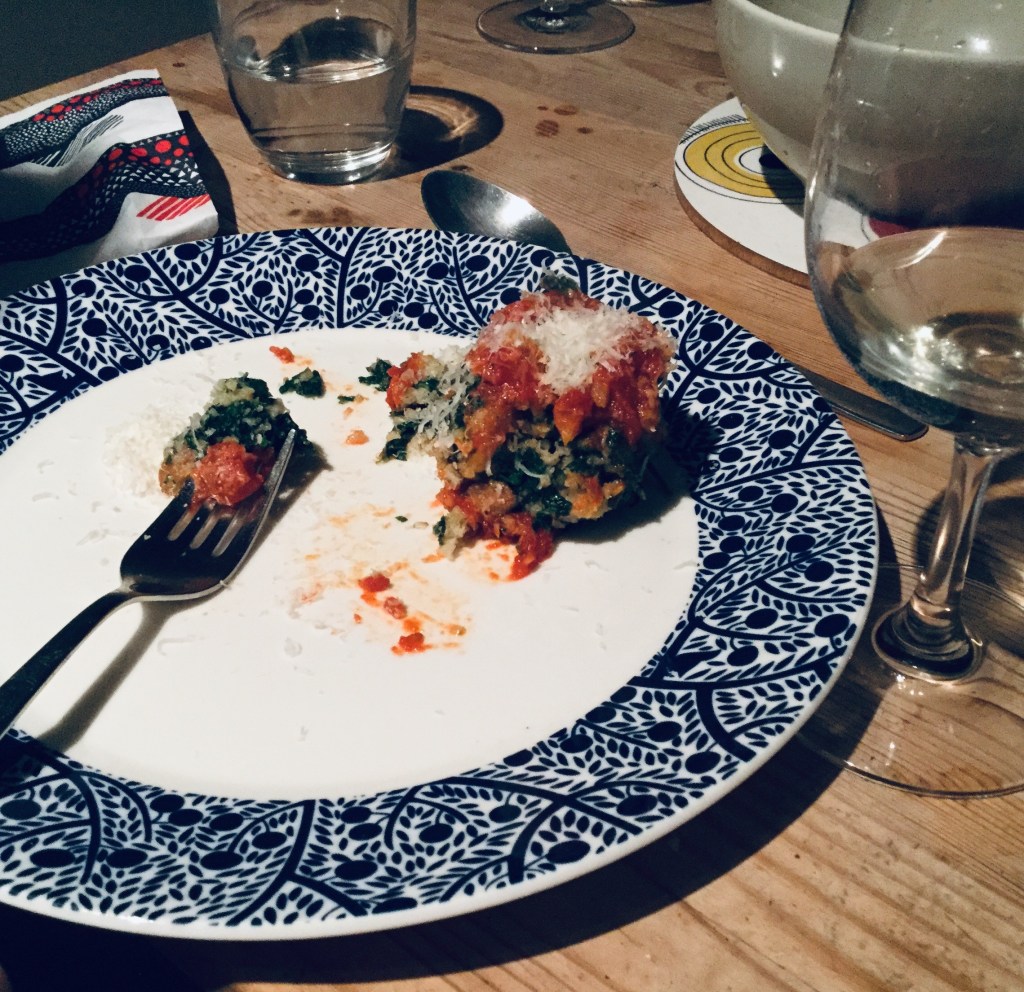
Unphotogenic and unfashionable, Britain’s embrace of continental dishes rarely stretches as far as bread dumplings. In English, even the name sounds unromantic and stodgy, like they taste of punishment and flavourless desperation. My photography is unlikely to do anything to challenge this but you’ll need to trust me on the taste. In other nation’s hands, bread dumplings are a very wonderful thing.
For the first in potentially quite a long series of dumpling recipes, we head to the Austrian-Italian borders, an epicentre of the bread dumpling world. Spinatknödeln were the first bread dumplings I ate and the first I ever tried to recreate. To understand their appeal, jettison thoughts of grey lumps of stodge and imagine dumplings made to be eaten after a long Alpine hike amid the sparklingly sunny and relentlessly spectacular beauty of the Dolomites. These dumplings are pretty much everywhere, in simple Alpine huts and fancy hotels, on deli counters and supermarket shelves. Frequently they are served as part of trios of different flavoured dumplings, the spinach ones sitting alongside others flavoured with bacon, beetroot or cheese.

Here dumpling nomenclature is a linguistic minefield that reflects a history of border struggles. One town may speak German, the next Italian and the local Ladin dialect confuses this further. In the Trentino-Alto-Adige/Süd Tirol region, they are frequently called Spinatknödel or Canederli but they also get reshaped and renamed as Strangolapreti (priest stranglers – a great name for a Netflix crime series set among papal power struggles and intrigue). To confuse matters further, the Anglicized version below is only slightly adapted from the recipe for Spinach Malfatta in my well-used copy of the excellent Sarah Raven’s Garden Cookbook, yet malfatti are more commonly made from spinach and ricotta rather than breadcrumbs.
So opt for the name of your choice and give this version a go. These are Anglicized – and not exactly traditional – for practical reasons. The dumplings are usually made from tiny cubes of the Semmel rolls that are popular in this region with a crunchy crust and fluffy white interior. Because they stale quickly, leftovers are often transformed into breadcrumbs or cubes and some bakeries in the regions sell these in cellophane packets. In the absence of a semmel roll supply, I’ve followed Sarah Raven in making mine with white breadcrumbs.
There is also nothing traditional about how I usually serve them. In Italy, the dumplings usually appear topped with brown butter or made into a slightly smaller balls served bobbing in a vegetable broth. Here, I’ve topped them with a tomato sauce in a very Britalian style. The sauce is nothing more than a couple of cloves of chopped garlic sautéed gently in a little olive oil, joined by a can of plum tomatoes, seasoning and half a teaspoon of sugar, and left to simmer for 50 minutes with an occasional stir to break down the tomatoes into a sauce.
Spinatknödel
Serves 2 as a main course.
Ingredients
- 500g spinach
- 100g white bread
- 1 small clove garlic
- 50g pecorino cheese (or parmesan or grana padano)
- 1 egg white
- 1 tbspn parsley
- 1 tbspn plain flour
- ½ tspn finely grated nutmeg (or more to taste)
- Extra cheese for grating over the top
Method
- If you’re using large spinach leaves, chop off the stems. Wash the spinach before stuffing it in a large pan filled with a little boiling water. Press the top bits down periodically to ensure it all cooks. Once it is cooked – it will only take a few minutes – drain the spinach.
- The next stage is crucial as waterlogged spinach is the enemy of a good dumpling mix. Once the spinach has cooled slightly, squeeze it out with your hands. Then put it in your least favourite tea towel, wrap it up, squeeze it like mad to extract the water, then squeeze it some more.
- Remove the spinach from the tea towel and finely chop it. Leave it cool to room temperature.
- Meanwhile, get on with the rest of the prep. Bung the bread in a food processer and pulse to make fairly chunky breadcrumbs. Finely grate the cheese and the garlic. Finely chop the parsley. Add them all to a mixing bowl.
- Add the spinach (if it is still soggy, give it another squeeze before you do), flour and egg white to your breadcrumb mix and start mixing with your hands. Keep squelching the mix through your fingers until it all starts to combine into a spinachy-bready mass.
- Using your hands, form into golf-ball sized dumplings. I get about 12 dumplings from the mix. Put the dumplings to one side until you are ready to cook them. They’ll happily sit overnight in the fridge.
- Line a steamer with greaseproof paper perforated with a knife or skewer. Put the dumplings in the steamer, place over a pan of boiling water and pop on the lid. Steam for 10 minutes before carefully removing the dumplings.*
- The dumplings need room to breathe so you may want to do this in two batches. Do not worry about the first batch going cold – the just cooked dumplings have the nuclear temperature of the old-style McDonalds apple pie.
- Serve topped with a tomato sauce and grated parmesan.
Adapted from the recipe for Spinach Malfatta in Sarah Raven’s Garden Cookbook (Bloomsbury)
*It is quite possible to cook these without a steamer. I am simply too chicken to try. Place in a large pan of gently boiling water and cook as the Pasta Grannies do with a different type of canederli.
 one million loaves