Chocolate Bread Pudding

Humble breadcrumbs undergo a magical transformation in this surprisingly indulgent chocolate dessert that is much more than the sum of its parts. Uncooked, the mix of bread, cocoa, sugar and eggs initially looks pretty bleak but, once baked, it turns into a rich chocolate pudding with the texture of a slightly overcooked brownie. The addition of orange, cinnamon, dried fruit and nuts gives it an almost boozy festive flavour and a sense of decadence. A sprinkle of sugar over the top produces a crispy crust. 

The results are radically different from many other variations on a bread pudding. It has none of the custardy egginess of a British bread and butter pudding or an American bread pudding. The use of breadcrumbs rather than slices or chunks of bread produces a very different texture. But it also differs from the stodgy squares of bread pudding found in some traditional British bakeries – although dense and rich, it isn’t heavy or dry.

We often forget the cooking of the recent past in the quest for novelty or full-on retro fun. I was looking for the latter when I stumbled across Thane Prince’s 1991 recipe for this pudding in the Sunday Telegraph online archives. Quick and simple to put together, the richness of the results means that it feeds a surprising number of people. It is also heavy on the breadcrumbs so it’s a perfect use for forgotten bread.

I’ve adapted the recipe a little but it is easily customized to suit whatever dried fruits and nuts you possess. I substituted hazelnuts for the walnuts in the original but you could use pistachios or almonds. I liked the addition of dried fruit but they don’t need to be sour cherries – some dried cranberries or apricots would work well, or some raisins or sultanas (soaked in a little boiling water for 15 mins and then drained). The original recipe used a mix of white and brown breadcrumbs and this suited what I had in but white crumbs alone would be fine. Fairly fresh or slightly dry bread will work well but it shouldn’t be too hard. I’m intrigued to know how rye bread might work.

Feeds 8-12 people

Ingredients

  • 340g crustless bread (a mix of brown and white or just white)
  • 50g butter
  • 4 tbspn cocoa powder
  • 4 tbspn boiling water
  • 2 large eggs
  • 250ml milk
  • 170g soft brown sugar
  • 30g dried sour cherries, very roughly chopped (or alternative dried fruit)
  • 70g hazelnuts, roughly chopped (or alternative)
  • 1 tspn cinnamon
  • Finely grated zest of 1 orange 
  • Demerara sugar to sprinkle
  • Cream to serve

Method

  1. Preheat the oven to 180C/160C fan/Gas Mark 4. Butter a shallow baking dish (mine was a 22x22cm gratin dish). 
  2. Pulse the bread in a food processor to make fairly small crumbs.
  3. Melt the butter in a pan or microwave and leave aside to cool a little.
  4. Mix the cocoa with the boiling water in a cup to make a smooth paste. Add a little more water if necessary.
  5. Beat the eggs, add the milk and beat a little to combine.
  6. In a mixing bowl, combine the breadcrumbs, butter, cocoa paste, soft brown sugar, sour cherries, nuts, cinnamon and orange zest. Stir in the egg and milk mixture.
  7. Pour the everything into the baking dish and sprinkle with a little demerara sugar.
  8. Bake for about 45 mins or until the top feels crispy.
  9. Best served hot with lightly whipped cream. Also good cold the next day with cream straight from the pot.

Adapted from a recipe by Thane Prince, Sunday Telegraph 14 April 1991.
Alpine spinach and bread dumplings

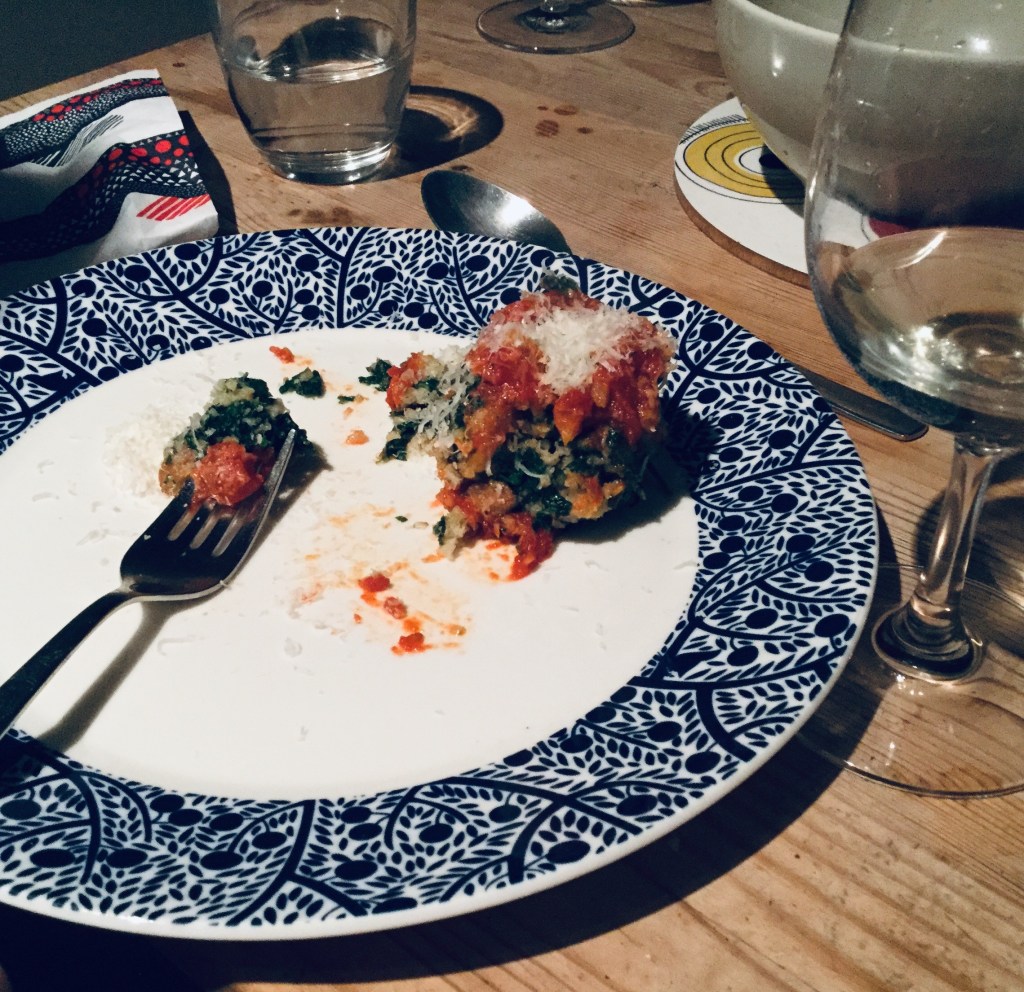
Unphotogenic and unfashionable, Britain’s embrace of continental dishes rarely stretches as far as bread dumplings. In English, even the name sounds unromantic and stodgy, like they taste of punishment and flavourless desperation. My photography is unlikely to do anything to challenge this but you’ll need to trust me on the taste. In other nation’s hands, bread dumplings are a very wonderful thing. 

For the first in potentially quite a long series of dumpling recipes, we head to the Austrian-Italian borders, an epicentre of the bread dumpling world. Spinatknödeln were the first bread dumplings I ate and the first I ever tried to recreate. To understand their appeal, jettison thoughts of grey lumps of stodge and imagine dumplings made to be eaten after a long Alpine hike amid the sparklingly sunny and relentlessly spectacular beauty of the Dolomites. These dumplings are pretty much everywhere, in simple Alpine huts and fancy hotels, on deli counters and supermarket shelves. Frequently they are served as part of trios of different flavoured dumplings, the spinach ones sitting alongside others flavoured with bacon, beetroot or cheese.

Here dumpling nomenclature is a linguistic minefield that reflects a history of border struggles. One town may speak German, the next Italian and the local Ladin dialect confuses this further. In the Trentino-Alto-Adige/Süd Tirol region, they are frequently called Spinatknödel or Canederli but they also get reshaped and renamed as Strangolapreti (priest stranglers – a great name for a Netflix crime series set among papal power struggles and intrigue). To confuse matters further, the Anglicized version below is only slightly adapted from the recipe for Spinach Malfatta in my well-used copy of the excellent Sarah Raven’s Garden Cookbook, yet malfatti are more commonly made from spinach and ricotta rather than breadcrumbs. 

So opt for the name of your choice and give this version a go. These are Anglicized – and not exactly traditional – for practical reasons. The dumplings are usually made from tiny cubes of the Semmel rolls that are popular in this region with a crunchy crust and fluffy white interior. Because they stale quickly, leftovers are often transformed into breadcrumbs or cubes and some bakeries in the regions sell these in cellophane packets.  In the absence of a semmel roll supply, I’ve followed Sarah Raven in making mine with white breadcrumbs. 

There is also nothing traditional about how I usually serve them. In Italy, the dumplings usually appear topped with brown butter or made into a slightly smaller balls served bobbing in a vegetable broth. Here, I’ve topped them with a tomato sauce in a very Britalian style. The sauce is nothing more than a couple of cloves of chopped garlic sautéed gently in a little olive oil, joined by a can of plum tomatoes, seasoning and half a teaspoon of sugar, and left to simmer for 50 minutes with an occasional stir to break down the tomatoes into a sauce.

Spinatknödel 

Serves 2 as a main course.

Ingredients

  • 500g spinach 
  • 100g white bread
  • 1 small clove garlic
  • 50g pecorino cheese (or parmesan or grana padano)
  • 1 egg white
  • 1 tbspn parsley
  • 1 tbspn plain flour
  • ½ tspn finely grated nutmeg (or more to taste)
  • Extra cheese for grating over the top

Method

  1. If you’re using large spinach leaves, chop off the stems. Wash the spinach before stuffing it in a large pan filled with a little boiling water. Press the top bits down periodically to ensure it all cooks. Once it is cooked – it will only take a few minutes – drain the spinach.
  2. The next stage is crucial as waterlogged spinach is the enemy of a good dumpling mix. Once the spinach has cooled slightly, squeeze it out with your hands. Then put it in your least favourite tea towel, wrap it up, squeeze it like mad to extract the water, then squeeze it some more.
  3. Remove the spinach from the tea towel and finely chop it. Leave it cool to room temperature.
  4. Meanwhile, get on with the rest of the prep. Bung the bread in a food processer and pulse to make fairly chunky breadcrumbs. Finely grate the cheese and the garlic. Finely chop the parsley. Add them all to a mixing bowl.
  5. Add the spinach (if it is still soggy, give it another squeeze before you do), flour and egg white to your breadcrumb mix and start mixing with your hands. Keep squelching the mix through your fingers until it all starts to combine into a spinachy-bready mass.
  6. Using your hands, form into golf-ball sized dumplings. I get about 12 dumplings from the mix. Put the dumplings to one side until you are ready to cook them. They’ll happily sit overnight in the fridge.
  7. Line a steamer with greaseproof paper perforated with a knife or skewer. Put the dumplings in the steamer, place over a pan of boiling water and pop on the lid. Steam for 10 minutes before carefully removing the dumplings.*
  8. The dumplings need room to breathe so you may want to do this in two batches. Do not worry about the first batch going cold – the just cooked dumplings have the nuclear temperature of the old-style McDonalds apple pie.
  9. Serve topped with a tomato sauce and grated parmesan.

Adapted from the recipe for Spinach Malfatta in Sarah Raven’s Garden Cookbook (Bloomsbury)

*It is quite possible to cook these without a steamer. I am simply too chicken to try. Place in a large pan of gently boiling water and cook as the Pasta Grannies do with a different type of canederli.

Croutons: Crunch Time for Salads

Using old bread to make croutons isn’t rocket science. But sometimes the most obvious things get forgotten. The crunchy bite of croutons offers substance and texture to salads. They are also an easy way to use up old bread, a possible explanation for the enduring appeal of the Caesar Salad to restauranteurs. As bread is a great carrier of flavour, croutons also offer ways of injecting additional spicy or herby dimensions to a salad. 

The bread should a little dry and past its prime but not so hard that it’s resistant to a knife and shatters (and results in a trip to A&E). You can use pretty much any bread, although thin sliced will give you a less chunky crouton. By ripping the bread you’ll get more crispy raggedy edges to crisp in oil, an important lesson from the best roast potatoes. Add them to whichever salad you fancy.

Although I’ve used za’atar to flavour the croutons in the recipe below, it is by no means necessary. Try other spices like cumin or chilli, chopped herbs like rosemary or crushed garlic. They’d also be great with just a simple oil and salt coating. 

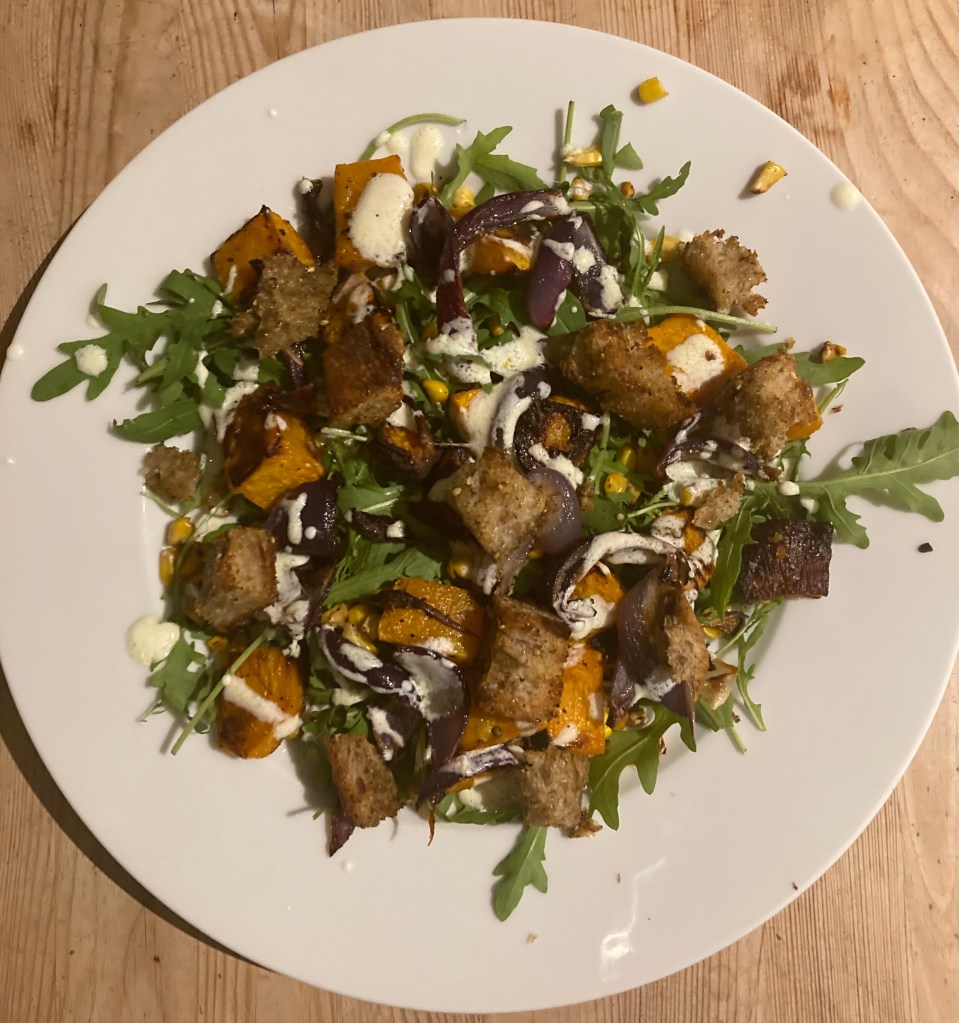
Squash, Sweetcorn and Onion Salad with Croutons

In this recipe, croutons add crispness to a warm salad featuring roast butternut squash, a vegetable that screams autumn like a broken boiler or (at least) a month of Halloween. It tastes – and looked – rather better than it appears in the photo!

This works as a substantial main course salad for two hungry people or will feed four as a small main or a side dish. The slightly charred onions offer a bitterness that balances out the sweetness of the squash and corn which is also offset by a tangy dressing. I first encountered this squash-onion partnership in an Ottolenghi salad recipe but I’ve departed considerably from his version here. Indeed, this is less of a recipe and more of a starting point. Substitute in the veg, spices or herbs you have or opt for an oil and vinegar dressing to veganize things.

Ingredients

  • a medium butternut squash (approx. 800g)
  • 1 large red onion
  • 1 tbspn olive oil
  • a corn on the cob (or 120g frozen sweetcorn*)
  • 50g rocket

For the croutons:

  • 80g stale bread (preferably a thick slice)
  • 1 tbspn olive oil
  • 2 tspn za’atar (or spices/herbs you have to hand)

For the dressing:

  • 3 tbspn Greek yogurt
  • 1 tbspn olive oil
  • Squeeze of lemon

Method

  1. Preheat the oven to 220C/200C Fan.
  2. Peel and seed the squash and then chop into approx. 2cm square pieces. Peel the red onion. Cut it into quarters from top to bottom and then cut each quarter into approx. 3 wedges. If the wedges fall apart, don’t worry.
  3. Place the squash on one side of a baking tray and the onions on the other. Drizzle with the olive oil and add a good hit of salt and black pepper. Then toss each veg around in the oil and seasoning to coat them.
  4. Put in the oven. After roughly 30 mins remove the onions (they should be soft, browned and a little bit frizzled but only lightly charred). Cook the squash for another 15 mins or until cooked and slightly charred. 
  5. Meanwhile, you can get on with the rest of the prep. Carefully shave the corn kernels off the cob with a large knife. Heat a non-stick frying pan on high and then add the corn and cook for approx. 5 minutes, stirring occasionally, until partly charred and toasted and starting to pop. Remove from the pan.
  6. For the dressing: combine the yoghurt, oil and lemon. Season well with salt and pepper and give it a good stir.
  7. For the croutons: mix together the oil and za’atar in a bowl. Chop or rip the bread into chunks, add to the oil-za’atar mix and squish around with your hands until the bread is well coated.
  8. Once the squash is cooked, remove from the baking tray and reduce the oven temperature to 200C/180C fan. Spread out the bread on the baking sheet and roast for 10 minutes or so until golden brown and crispy.
  9. Scatter the rocket, sweetcorn, onions and squash over your plates. Drizzle with the dressing and top with the croutons.

*If using frozen sweetcorn, allow to defrost for about 15 mins before toasting it in the pan.

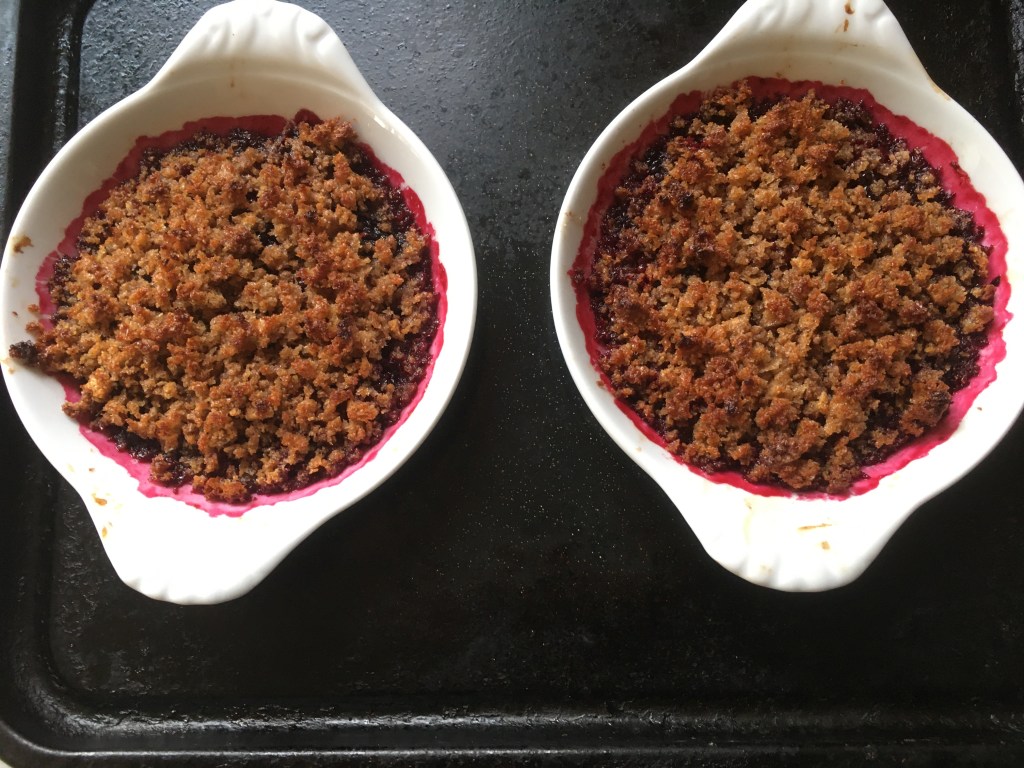
Blackberry ‘Brumble’

A cross between a British crumble and an American betty, this is an incredibly easy dish in which jammy fruits are baked under a crisp, sweet and buttery breadcrumb crust. While many recipes for Betty layer breadcrumbs and fruit – especially in its classic apple version – this simplifies matters further to produce a surprisingly good crumble alternative. The combination of fruit, sugar, cinnamon and butter gives it the distinctive whiff of American bakeries.

The recipe below takes its inspiration from two very different sources – a column on ‘uncommon’ apple dishes in a 1922 edition of the Daily Mail and a recipe for a stone fruit betty in Tom Hunt’s Waste Not column in the Guardian. Hunt’s is fancier (adding nuts) and vegan (using olive oil instead of butter). The Mail version is more thrifty and uses margarine instead of butter. 

Following Hunt’s example, I’m sure this would be lovely with any jammy stone fruit such as plums and damsons. My version used foraged blackberries but, before you get images of fruit picked on idyllic country lanes, mine came from a side alley near the garages on a local council estate that had been spotted by a friend.

This is very customizable. Substitute whichever fats you have for the butter.  This makes it easily veganized.  I used 3-day old wholemeal bread but this should work with pretty much any old loaf – white, brown, granary, seeded – although I’d avoid one that is rock hard. I removed the crusts before making the crumbs but it’s not essential. Substitute the caster sugar for whatever sugar you have. Do some maths and increase or decrease the quantities for what you have. These quantities make two large portions or four small ones. 

Ingredients

  • 45g butter
  • 100g wholemeal bread
  • 30g golden caster sugar
  • 3/4 teaspoon cinnamon
  • 250g blackberries
  • a further 2 dessertspoons of caster sugar

Method

  1. Heat the oven to 200C/180C fan/Gas Mark 6.
  2. Melt the butter.
  3. Throw the bread in a food processor and whizz until you have crumbs. Alternatively, just chop or rip up your bread. It doesn’t really matter if you have small pieces rather than crumbs.
  4. Combine the bread, melted butter, 30g sugar and cinnamon.
  5. Cover the bottom of a shallow ovenproof dish with the blackberries to make a generous layer. (I didn’t have one the right size so I used two small ones). Sprinkle with 2 dessertspoons of sugar.
  6. Top with the breadcrumb mix and bake for 20-30 minutes until the fruit is bubbly and the top is browned and crispy.
  7. Serve with what you like. I used creme fraiche but cream, ice cream or custard would all be good. Serve hot or cold.